


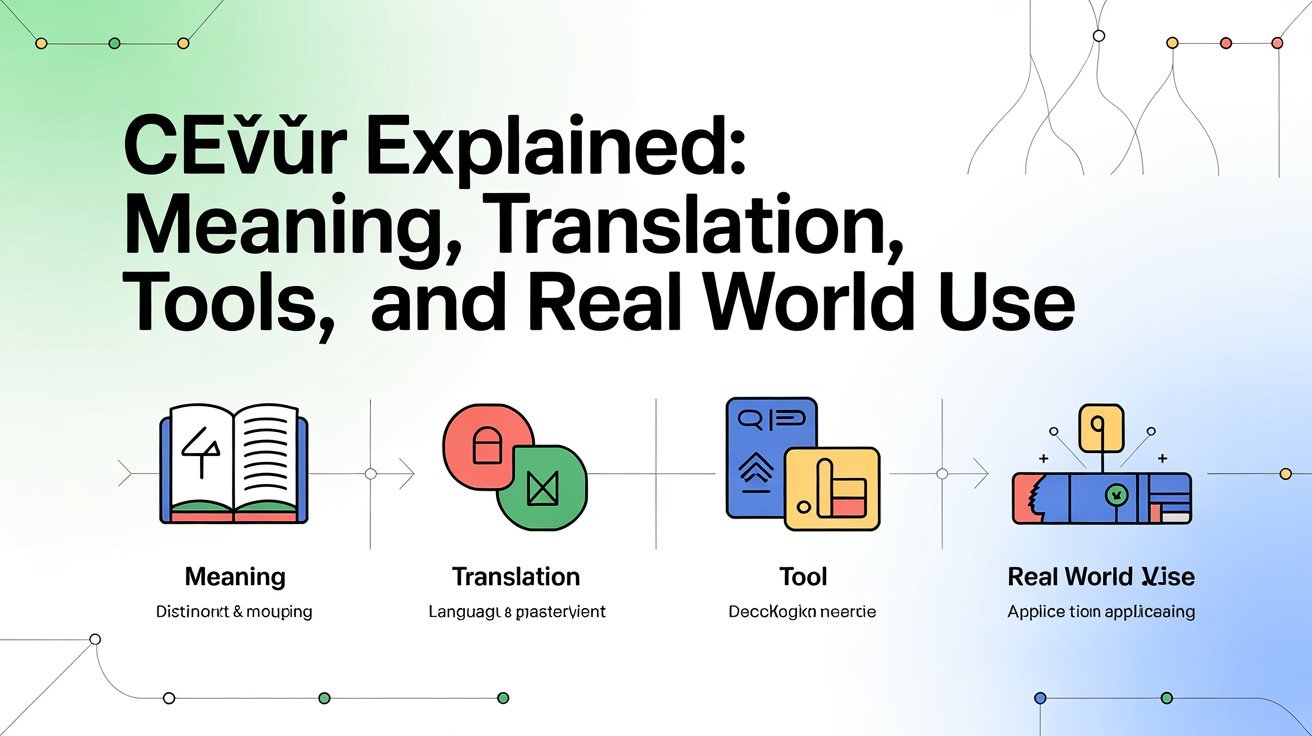

The word ceıvır is often searched online by people who want to translate text from one language to another. In most cases, it is a typing variation of the Turkish word çevir, which means translate or turn into another language. Many users type ceıvır instead of çevir because of keyboard limitations or habit.
In real life, when someone writes ceıvır, they usually want to say something like “translate this” or “convert this language.” Search engines understand this behavior, which is why ceıvır has become a searchable keyword even though it is not the correct spelling.
This is a good example of how language evolves online and how people use simplified or incorrect forms to communicate faster.
Why People Search for Ceıvır
People search for ceıvır for many practical reasons. Some want to translate homework. Others want to understand a foreign message. Many travelers use translation tools when visiting another country. Business owners also rely on translation to talk with international clients.
From my personal experience, I first used online translation tools when I received an email in Turkish that I could not understand. I typed the word into a search engine, found a translation tool, and suddenly the message made sense. That moment showed me how powerful simple translation can be.
The demand for quick translation is growing every year because the internet connects people from all over the world.
Understanding Translation in Simple Words
Translation means changing words from one language into another language while keeping the meaning the same. It sounds simple, but it can be very complex.
Languages have different grammar rules, sentence structures, and cultural meanings. A word in Turkish may not have an exact match in English. That is why translation requires understanding, not just replacing words.
For beginners, translation tools are helpful because they give instant results. However, they are not perfect, and understanding their limits is important.
How Online Translation Works
Online translation tools use computer systems to analyze text. Modern tools use artificial intelligence and machine learning. These systems are trained using millions of real translations.
When you type text into a ceıvır or translation tool, the system looks for patterns. It compares your sentence with similar sentences it has seen before. Then it predicts the best possible translation.
This process happens in seconds, which feels almost magical. But it is still a machine making guesses based on data.
Popular Ceıvır and Translation Tools
There are many tools available today that people use as ceıvır tools.
Google Translate is the most popular option. It supports many languages and is easy to use. Other tools include DeepL, Microsoft Translator, and Yandex Translate.
Each tool has strengths and weaknesses. Some are better for European languages. Others handle Asian languages better. In my opinion, DeepL often produces more natural sentences, but Google Translate is more flexible.
Trying multiple tools is often the best approach when accuracy matters.
My Personal Experience Using Translation Tools
I have used online translation tools for writing, reading, and communication. When I started learning a new language, translation tools helped me understand basic words quickly.
However, I also noticed mistakes. Sometimes the translated sentence sounded strange. Other times, the meaning was slightly wrong.
This taught me an important lesson. Translation tools are helpers, not replacements for human understanding. They are great for learning and speed, but not always perfect.
Accuracy Problems in Online Translation
Accuracy is the biggest challenge in online translation. Machines do not fully understand emotions, humor, or cultural references.
For example, idioms often get translated incorrectly. A phrase that makes sense in Turkish might sound confusing in English.
That is why professional translators still matter. For legal documents, medical content, or business contracts, human translation is safer.
Also Read: Anonibs Explained
Human Translation vs Machine Translation
Human translators understand context, tone, and intention. Machines focus on data patterns.
Machine translation is fast and cheap. Human translation is slower but more accurate.
In real life, many people use both. They use ceıvır tools for quick understanding and human translators for important work. This balanced approach works best.
How to Use Ceıvır Correctly
To get better results from translation tools, follow simple tips.
Use clear sentences. Avoid slang. Check the translation in reverse. Read the result carefully.
If something feels wrong, it probably is. Trust your judgment and compare with other tools.
Translation for Students, Travelers, and Businesses
Students use translation to learn languages and understand textbooks. Travelers use it to read signs and menus. Businesses use it to communicate globally.
Without translation tools, global communication would be slower and harder. Ceıvır tools help remove language barriers and bring people closer.
EEAT and Trust in Translation Content
EEAT stands for Experience, Expertise, Authoritativeness, and Trustworthiness.
Good translation content should be created by people who understand language. Tools should be transparent about limitations. Users should always verify important translations.
Trust comes from honesty and accuracy, not from pretending machines are perfect.
The Future of Translation Technology
Translation technology is improving fast. Voice translation, real time subtitles, and smart devices are becoming common.
In the future, language barriers may almost disappear. But human understanding will still matter because language is more than words.
Conclusion
Ceıvır represents more than just a word. It represents the human need to understand and be understood. Translation tools make life easier, but they work best when used wisely.
From students to travelers to businesses, everyone benefits from translation. Knowing how to use these tools correctly helps avoid confusion and mistakes.
Translation connects the world, one word at a time.
Frequently Asked Questions
What does ceıvır mean
Ceıvır is commonly used as a variation of the Turkish word çevir, which means translate.
Is ceıvır a real word
It is not the correct spelling, but it is widely used online as a search term.
Are online translation tools accurate
They are helpful but not perfect. Accuracy depends on language and context.
Can I trust translation tools for important documents
For important content, human translation is recommended.
Which translation tool is best
There is no single best tool. Trying multiple tools gives better results.






Leave a Reply